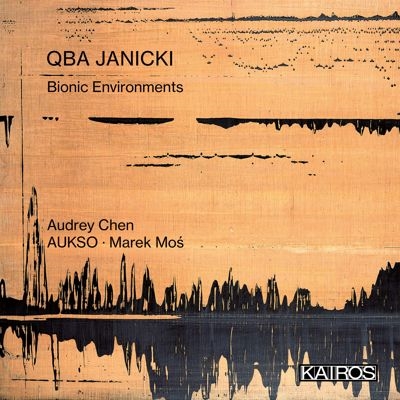
ついにkairosがエレクトロニカクラブ畑の作曲家を取り上げることになったのか?
どちらにしても久しぶりに強烈に脳内にインバクトを与えるこの作品、
二か月待ちでようやくCDを手に入れることができうれしい。
方法論として理解しやすいKAIROSによるCDの解説を以下に載せる。
Has Kairos finally decided to feature a composer from the electronica club scene?
In any case, I am delighted to have finally obtained the CD—after a two-month wait—of a work that delivers such a powerful impact on the mind.
Below, I have included Kairos's commentary on the CD, which offers an easily understandable explanation of the compositional approach.
Qba Janickiによる『Bionic Environments』は、有機的な物質と機械的知性が融合し、絶えず進化し続ける一つの有機体へと変貌していく様を描き出した音響作品です。増幅された響板、エレクトロニクス、電気機械装置、拡張されたヴォーカル、そして弦楽オーケストラのために作曲された本作は、生物学的な変異と人工的な建築構造の狭間に浮かぶハイブリッドな環境を巡る、映画的でありながらも極めて物質的な旅として展開されます。
この作品は、直線的な物語を語るのではなく、没入感のある知覚空間を構築します。そこでは、広大なスペクトルの風景が、微細な音響現象、隠されたテクスチャー、不安定な共鳴、そして人間・機械・環境の間に生じる繊細なコミュニケーションのありようと共存しています。聴き手は、絶えず変容し続ける音の地形に自らの想像力を投影しながら、これらの領域を直感的に移動するよう誘われます。
この作品の核心には、予測不可能性と体系化との間の緊張関係が存在します。ヤニツキは、デジタル処理を施した弦楽オーケストラを、独自に製作した電気音響・電気機械楽器、拡張されたヴォーカル・テクニック、フィードバック・システム、そして不安定な電子構造体と組み合わせています。ここでアコースティックな音は、固定された素材として機能するのではなく、変異や拡張、さらには機械的な干渉にさらされる「生きた有機体」として扱われています。
本作の構成は、制御されたアレアトリズム(偶然性の導入)と自由な即興演奏に基づいています。不確定な要素と緻密な構成構造が共存することで、作品は有機的な不安定さとアルゴリズムによる規律との間を行き来します。その結果、『Bionic Environments』は、技術的挙動と生物学的挙動が対立するのではなく、共生関係の中で機能し合うような音響言語を提示しています。
Bionic Environments by Qba Janicki is an illustrative sonic work in which organic matter and mechanical intelligence merge into a single, continuously evolving organism. Composed for amplified soundboard, electronics, electromechanics, extended voice, and
string orchestra, the piece unfolds as a cinematic yet deeply material journey through hybrid environments suspended between biological mutation and synthetic architecture.
Rather than telling a linear story, the com position constructs immersive perceptual spaces in which vast spectral landscapes coexist with microscopic sonic events, hidden textures, unstable resonances, and fragile forms of communication between human,
machine, and environment. The listener is invited to move intuitively through these territories, projecting their own imagination onto an ever-transforming sonic topography.
At the core of the work lies a tension between unpre dictability and systematisation. Janicki combines a digitally processed string orchestra with custom-built electroacoustic and electromechanical instruments, extended vocal techniques, feedback systems, and
unstable electronic structures. Acoustic sound does not function here as a fixed material, but rather as a living organism subjected to mutation, expansion, and mechanical interference.
The composition is based on controlled aleatorism and open improvisation. Elements of indeterminacy coexist with precise compositional structures, allowing the work to oscillate between organic instability and algorithmic discipline. As a result, Bionic Environments proposes a sonic language in which technological and biological behaviours cease to oppose one another, instead beginning to function within a shared symbiosis.
また、QBA JANIKIの紹介も載せておきます。(インスタグラムより)
クバ・ヤニツキ(Qba Janicki、1989年2月6日ポーランド・ブィドゴシュチュ生まれ)は、クラブ「MÓZG(モズグ)」を中心とする芸術コミュニティから登場した作曲家、マルチインストゥルメンタリスト、プロデューサーです。ポーランド国内外で精力的に活動し、ロスコ・ミッチェル、イェジ・マゾル、スワヴェク・ヤニツキ、トマシュ・スロチンスキ、近藤等則、ペーター・ブロッツマン、マッツ・グスタフソン、テオニキ・ロジネクといった、国際的な即興音楽や実験音楽シーンの著名なアーティストたちと共演を重ねてきました。
現在はソロ・アーティストとして活動するほか、Malediwy(マレディヴィ/マレク・ポスピェシャルスキとの共演)、T’ien Lai(ティエン・ライ/ヤクブ・ジオウェク、ウカシュ・イェンジェイチャクとの共演)、Marek Pospieszalski Octet、AJAKS(アヤクス/マレク・ポスピェシャルスキ、マックス・ムハとの共演)、そしてグリシャ・リヒテンベルガーとのデュオなど、いくつかの重要なプロジェクトに参加しています。コンサート活動に加え、演劇作品の作曲も手がけており、クシシュトフ・ガルバチェフスキ、HERTZ HAUS、マチェイ・ポドスタヴニ、ラモナ・ナガブチンスカ、パヴェウ・ウィサクといった評価の高い演出家やコレクティブと協働しています。
彼の芸術的実践と独自の音響言語は、フリー・インプロヴィゼーション(自由即興音楽)、エレクトロニック・クラブ・ミュージック、サウンド・アートという、彼が関心を寄せる3つの主要な領域の融合から生まれています。自ら設計した楽器環境を用い、個々の卓越した演奏技術、音に対する構造的なアプローチ、そして形式的な精密さを組み合わせることで、現代音楽の現実に対する深い理解に根ざした独自の音響言語を展開しています。
演奏家や作曲家としての活動に加え、文化振興やコミュニティ形成の取り組みにも積極的に携わっています。「Fundacja MÓZG(モズグ財団)」および「Stowarzyszenie Grupa Sokołowska(ソコウォフスコ・グループ協会)」の副代表として、ブィドゴシュチュ、ワルシャワ、ソコウォフスコの各地で数多くの学際的なイベントを共同企画しており、その中には同財団の主要プロジェクトである「MÓZG Festival」も含まれます。
I have also included an introduction to QBA JANIKI.
Qba Janicki, born 6 February 1989 in Bydgoszcz, Poland, is a composer, multi-instrumentalist, and producer emerging from the artistic community centered around the MÓZG club. Actively performing in Poland and abroad, he has collaborated with
distinguished figures of the international improvised
and experimental music scene, including Roscoe Mitchell, Jerzy Mazzoll, Sławek Janicki, Tomasz Sroczyński, Toshinori Kondo, Peter Brötzmann, Mats Gustafsson, and Teoniki Rożynek.
He currently performs both as a solo artist and within several key collaborative projects, including Malediwy (with Marek Pospieszalski), T’ien Lai (with Jakub Ziołek and Łukasz Jędrzejczak), the Marek Pospieszalski Octet, the trio AJAKS (with Marek Pospieszalski and
Max Mucha), and a duo with Grischa Lichtenberger. Alongside his concert activity, he also composes music for theatre productions, collaborating with acclaimed directors and collectives such as Krzysztof Garbaczewski, HERTZ HAUS, Maciej Podstawny,
Ramona Nagabczyńska, and Paweł Łysak.
His artistic practice and sonic language emerge from the fusion of three principal areas of interest: freely improvised music, electronic club music, and sound art. Through self-designed instrumental
environments, Janicki combines individual virtuosity, structural approaches to sound, and formal precision, developing a distinctive sonic language rooted in a profound understanding of contemporary musical realities.
Beyond his work as a performer and composer, Janicki is also actively engaged in cultural animation and community-building initiatives. As vice-president of the Fundacja MÓZG and the Stowarzyszenie Grupa Sokołowska, he co-organizes numerous
interdisciplinary events in Bydgoszcz, Warsaw, and Sokołowsko, including the foundation’s flagship project, the MÓZG Festival.
instagram.com/qbajanicki